Seeing Business Like a Language Model
 Seeing Business Like a Language ModelBusiness principles work—until they don't. What matters is building gut-level next token prediction. I'm writing a book about the worldview I've developed by writing, coding, and living with AI. Last week I published the second piece from it, about how AI will impact science. Here's the third, about how AI will impact business.—Dan Shipper Was this newsletter forwarded to you? Sign up to get it in your inbox. As a young entrepreneur, I once thought of myself as an information processing machine. I got interested in mental models like Clay Christensen's disruption theory and Ray Dalio's Principles. I took copious notes and spent countless hours organizing them; I felt tremendous pressure to memorize these "rules" so that I could apply them in my business life. But in doing all this intellectual work, I had a nagging feeling: How would I remember to apply them in the situation that demanded it? I also saw entrepreneurs around me trying to apply similar rules, with mixed success. It sounds like a bad joke: A Wharton student goes to their first class on negotiation and learns about anchoring, then walks into their next negotiation proposing a price that's 10 times too high because they think it'll properly anchor the potential customer when instead it just pisses them off. We're not the only entrepreneurs and capitalists who envy science and rationality and try to apply it to business. In the late 1700s, Adam Smith, explicitly inspired by Isaac Newton, attempted to discover universal laws of economics—and popularized the idea of the market's invisible hand. In the early 20th century, Frederick W. Taylor attempted to optimize businesses scientifically, proposing that workers should be studied like machines, with every motion analyzed and improved for maximum efficiency. In the 1970s, Michael Porter's "Five Forces" framework tried to explain business success as a factor of elementary forces like the bargaining power of suppliers and the threat of new entrants. Christensen's disruption theory attempted to explain how startups unseat incumbents; his jobs-to-be-done framework is something like an atomic theory for appealing startup opportunities. Eric Reis's The Lean Startup framed startups as laboratories and entrepreneurs as scientists testing product hypotheses. We've even come to simple, "universal" definitions for the goal of business—maximizing shareholder value—and the fundamental value of businesses: their expected future cash flows. Why has this way of looking at business been so appealing? First, it is undeniably helpful. Rigorous analytical thinking, reduction, and abstraction are critical to new products and technologies, and to the coordination of people and matter required to operate any kind of business—especially large ones. Second, the total elimination of uncertainty is, for some, the holy grail of business. Guaranteed return, no risk—that would be a great business indeed. An infinite money machine, where all you have to do is pull the lever. If that's what you're looking for—elimination of uncertainty—it is appealing to look for some form of authority to tell you what to do. Science and logic carry the most authority in the modern world. And just like nobody ever got fired for buying IBM, nobody ever got fired for being too scientific, rigorous, and analytical in their thinking. But as much as reduction and rigorous thinking can be helpful—or even critical—in business, our attempts to turn it into a science like physics are mostly window-dressing, just like our attempts with social sciences in academia.  Build a project in a single dayAI can feel abstract until you build something real—and tools "made for programmers" can stop you before you start. Spend one day with Every's Dan Shipper to get acquainted with the best tools on the market, assign your AI agents real tasks, and ship something live. Claude Code for Beginners runs Nov. 19, live on Zoom. You'll leave with a project, a reusable workflow, and a head start on building the agentic apps that will populate the future. Many paths to the same result, the same paths to different resultsComplex systems like neural networks or human psychology exhibit what's called equifinality—where many paths can lead to the same result—and multifinality—where the same path can lead to very different results. This applies to business as well. Take Christensen's theory of disruption. It mapped quite well to disk drives and steel mills in the late 1980s and early 1990s, where established companies focused on high-end customers while new entrants captured the low end before moving upmarket. However, this pattern doesn't always hold true. Apple's iPhone, for instance, entered at the high end of the market and maintained that position. Netflix started by competing directly with Blockbuster's core business. Disruption theory is useful, but it's less a universal law like gravity and more of a helpful heuristic. Conversely, copying successful strategies often fails. When JC Penney hired Apple's retail chief Ron Johnson, they attempted to replicate Apple's retail strategy—but the same approach that worked brilliantly for Apple led to disaster for JC Penney. Business principles are usually anecdotes presented as axioms. Anecdotes—stories—are incredibly valuable. But they get misused when they are assumed to be general laws. In business, what's most important is to be able to see the landscape clearly for yourself. It's helpful to know theory and to know history—to take bits and pieces of what has worked for others and apply them to your situation—but usually the best businesses are hard to explain in terms of the past, just like paradigm-shifting scientific ideas are hard to explain in terms of previous theories. Why is this? For one, controlled experiments are close to impossible in business. Sure, you can A/B test a headline or a product's price, but what you choose to test is significantly more important than which test wins. You and I can both use the same A/B testing tool as Mr. Beast to find which YouTube thumbnails will perform better, but Mr. Beast's will win because he knows the frame or context for a good experiment far better than we do—and what a good frame is must always be partially inexplicit and subject to change. Beyond that, you can't A/B test major strategic decisions. You can't simultaneously run a company with two different CEOs or expand into two different markets with the exact same resources. The complexity of business environments, with countless variables from market conditions to employee dynamics, makes true scientific experimentation impractical. As a result, cause and effect are very difficult to establish. For another, business systems exhibit what chaos theorists call "sensitive dependence on initial conditions"—the famous butterfly effect. A small difference in timing, a slight variation in market conditions, or a minor change in team dynamics can completely alter the trajectory of a business decision. These changes can be so small as to be imperceptible; what appears to be the same situation can evolve, over time, into an entirely different outcome. This points to an even deeper challenge with business laws and principles: They only hold under certain conditions, but those conditions can never be fully specified in advance. Not only does disruption theory not work in the case of the iPhone, but we can't create an exhaustive list of when it will or won't work. New factors and forces constantly emerge that can invalidate previously reliable principles. Sometimes these are dramatic—like how a global pandemic suddenly made remote-first companies viable in ways that defied conventional wisdom about organizational culture. But often the changes are more subtle: gradual shifts in consumer behavior, technological capabilities, or competitive dynamics that accumulate until, seemingly overnight, old rules no longer apply. Even more challenging is that the conditions that make a principle work or fail aren't just about external factors but complex interactions between multiple variables. Netflix succeeded by directly competing with Blockbuster because of the specific combination of its team's capabilities, Blockbuster's weaknesses, shifting consumer preferences, and the evolution of broadband infrastructure. Change any one of those variables slightly, and Netflix might not be the dominant streaming platform it is today. This is why business principles are simultaneously useful and dangerous. They help us make sense of patterns we observe, but the moment we treat them as universal laws, we become blind to what makes them work or fail in any given situation. The key is not to abandon principles entirely, but to hold them loosely—always ready to notice anomalies that signal the game has changed. Perhaps most challenging of all is the inherent subjectivity in business. Entrepreneurs are encouraged to think objectively about which problems to solve, to do customer research like scientists. But customers rarely tell you directly what to build. Figuring out what people want—really want—calls for grasping two principles from our new worldview: context as priceless and knowledge as participatory. The context of a customer's response is shaped powerfully by what you put in front of them. What you put in front of them is a creative act. And the participatory, creative nature of this process is as essential in business as it is in science, as it is in other areas of life. This difficulty in creating controlled experiments, sensitivity to initial conditions, vulnerability to hidden exceptions, and the essentially creative nature of new product innovation means that when we call something a "law" of business or a "force," we're talking about something inherently different than what we mean when we talk about laws in physics or chemistry. Business "laws" are more like patterns or tendencies that we observe, but they don't have the same predictive power or universal applicability. So how do we deal with this? Become a paid subscriber to Every to unlock this piece and learn about how business intuition develops like language models—through repeated exposure to context—and the eight paradigm shifts in the new worldview of business. 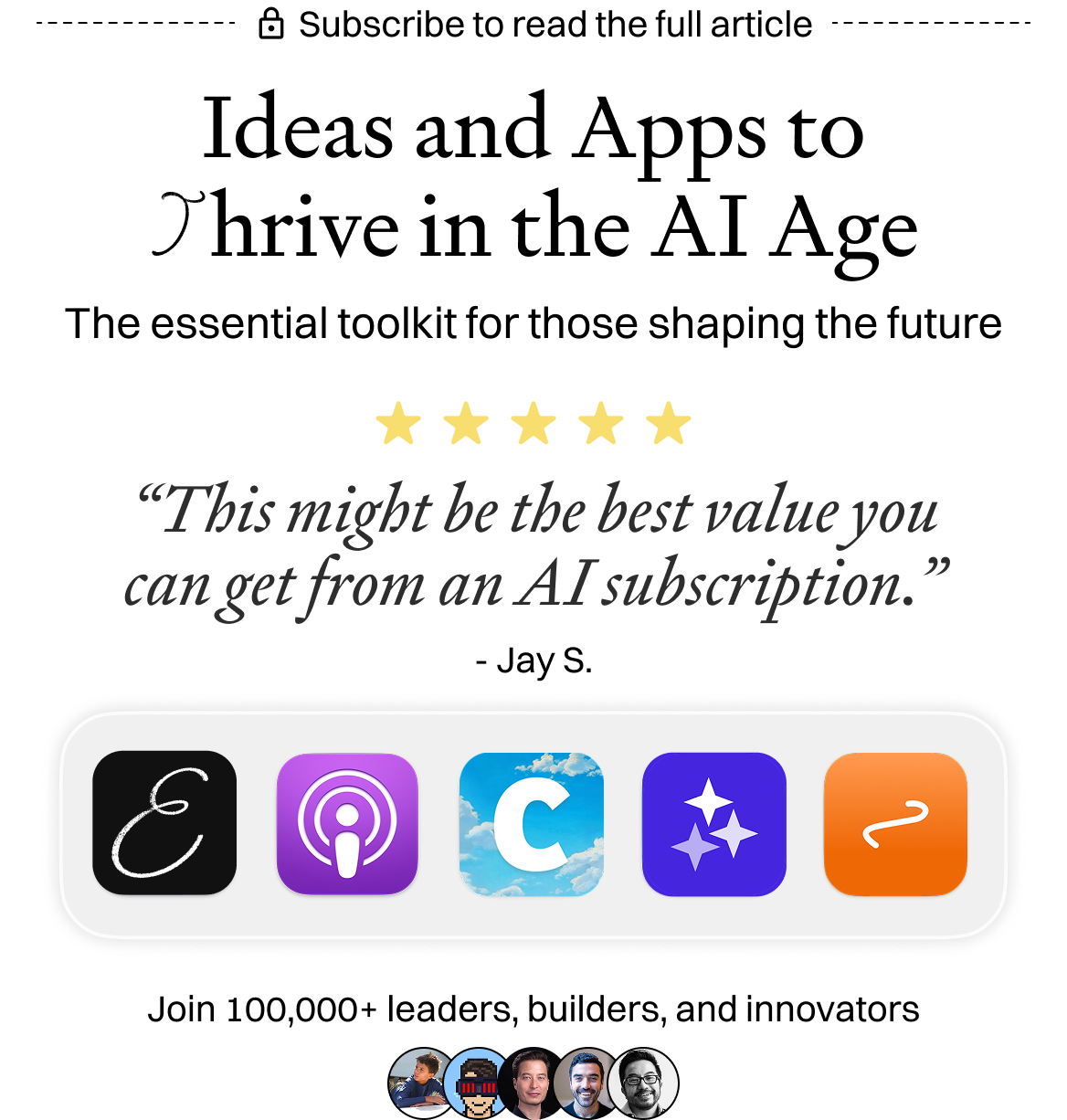 What is included in a subscription?Daily insights from AI pioneers + early access to powerful AI tools  Front-row access to the future of AI Front-row access to the future of AI  In-depth reviews of new models on release day Playbooks and guides for putting AI to work Prompts and use cases for builders In-depth reviews of new models on release day Playbooks and guides for putting AI to work Prompts and use cases for builders  Bundle of AI software Bundle of AI software  Sparkle: Organize your Mac with AI Sparkle: Organize your Mac with AI  Cora: The most human way to do email Cora: The most human way to do email  Spiral: Repurpose your content endlessly Spiral: Repurpose your content endlessly  Monologue: Effortless voice dictation for your Mac Monologue: Effortless voice dictation for your Mac |