The Never-done Machine
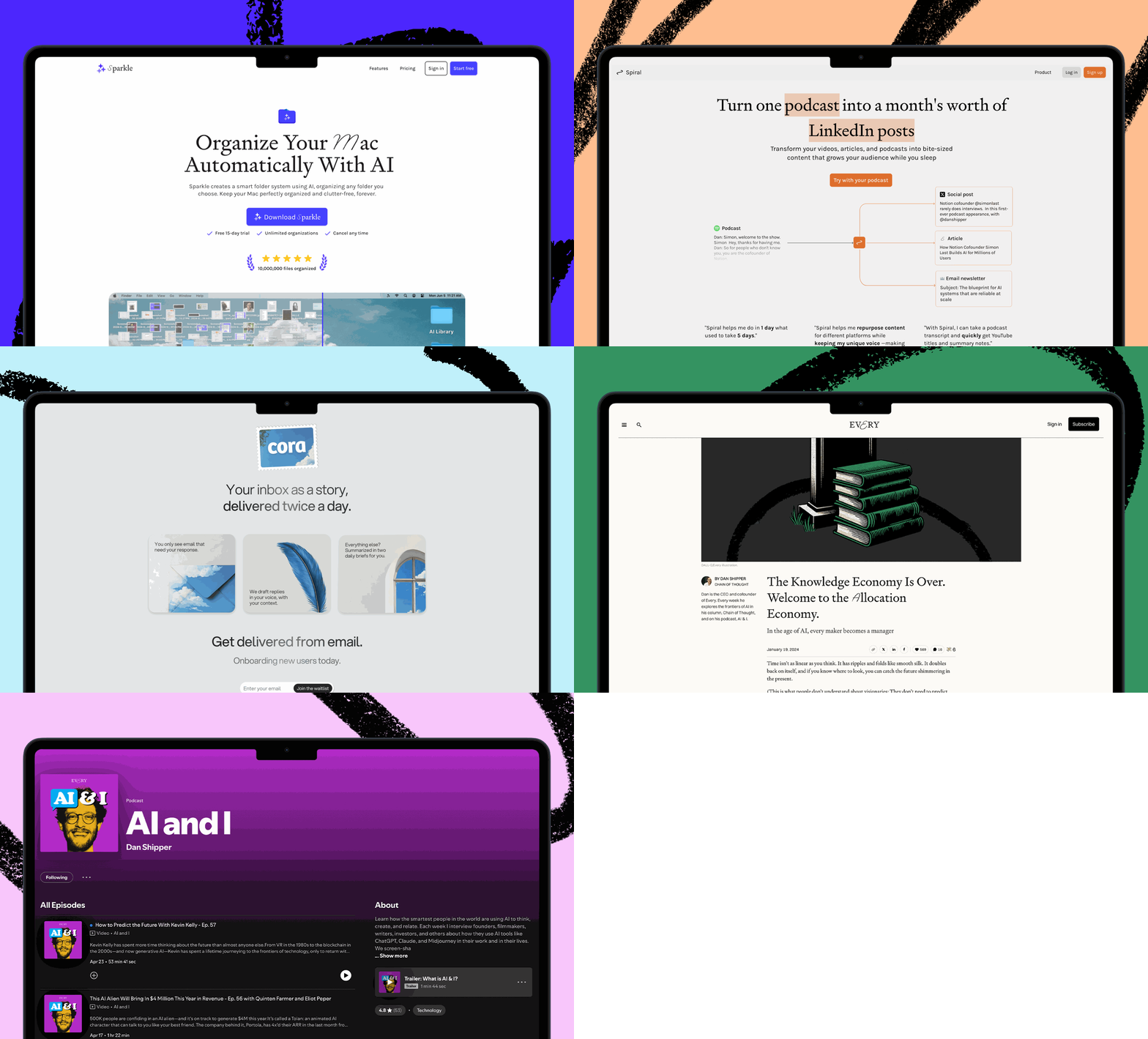
 The Never-done MachinePlus: Meet Proof, where agents and humans write together Hello, and happy Sunday! Was this newsletter forwarded to you? Sign up to get it in your inbox. Knowledge base"Introducing Proof" by Dan Shipper/On Every: We released a new product: Proof is a free, open-source document editor built for agents and humans to collaborate, with live editing, comments, change tracking, and simple visual cues that show who wrote what. At Every, we use it for everything from product plans to daily to-do lists. Read this to see how it works and try it yourself with a ready-made prompt for your agent of choice. "AI Was Supposed to Free My Time. It Consumed It." by Katie Parrott/Working Overtime: Every staff writer Katie Parrott sat down at lunch to work on a project with her new AI assistant and found herself prompting away until 1 a.m., a pattern that's become all too common for her and, as she discovered, plenty of others. Instead of reducing work, AI makes people want to do more of it, through task expansion, blurred boundaries, and a slot-machine dopamine loop. Read this for the psychology behind AI compulsion and tactics to help break the cycle. "The Science of Why AI Still Can't Write Like You" by Marcus Moretti: AI can demonstrate Ph.D.-level knowledge, but its writing remains stubbornly detectable, writes Marcus Moretti, the new general manager of our writing app, Spiral. New research reveals why: The most distinctive fingerprints of your prose come from subconscious choices—articles, pronouns, and function words that text analysis commonly filters out. Humans are also twice as varied in their writing as machines. Read this for what the science of style means for the future of AI writing tools. "Compound Engineering Camp: Every Step, From Scratch" by Katie Parrott/Source Code: At Every's first Compound Engineering Camp, Cora general manager Kieran Klaassen went from a one-line prompt to a working app in under an hour. He walked subscribers through every phase of the loop—brainstorm, plan, work, review, compound—showing how each step's output feeds the next and why he spends 70 percent of his energy on planning. Read this for the full live walkthrough and advice on the best models to use for each step. "How Main Street Companies Are Using AI" by Sam Gerstenzang/Thesis: Former Stripe product leader Sam Gerstenzang runs a funeral home and a medical spa platform—not exactly Y Combinator darlings. But as software gets easier to build, Sam (who writes his own newsletter) argues these operationally complex, real-world businesses are where AI can have the greatest impact. One of his most surprising findings is that when his team replaced human receptionists with AI, customers left faster—even though the error rate was identical. Read this for a grounded playbook on bringing AI to Main Street. Log onFrom the field. On Monday, March 16 at 3 p.m. ET, join Every's head of tech consulting and regular columnist Mike Taylor and editor in chief Kate Lee for a livestream about everything he's learned about teaching Claude Code to beginner-level students. From Every StudioCora opens up to your AI agentsCora now offers API tokens so you can connect your AI agents—Claude Code, OpenClaw, and others—directly to your inbox. Kieran built this for the growing number of users who want their agents to pull context from email without switching tools. From the new Agents page, you can set up a token, point your agent at Cora, and let it answer questions about your inbox on your behalf. Spiral gets smarter about learning your voiceSpiral launched two new ways to build a personal style guide—no copy-pasting required. Connect your X/Twitter account and Spiral pulls up to 1,000 of your recent tweets, weighted by engagement, to tune your work to what resonates with your audience. Or paste in any URL—a page, a full site, an RSS feed, or a sitemap—and Spiral automatically builds a style from up to 20 recent posts. Marcus also gave the editor a full polish: Spiral remembers your last-used style, autoscrolls as new text comes in, and handles attachments more intelligently. Try it out at writewithspiral.com. Collaborative filteringCode-free. Earlier this month, Dan Shipper was the guest on New Economies's Big Ideas podcast, where he talked about how he vibe coded Proof between meetings, how always-on agents are shaping the way our team works at Every, and why media distribution is the key competitive advantage now that software has become free to build. Watch or listen. AlignmentDigital twins. When I was 16, I spent a summer working with my dad in a welding factory. Apart from the acrid smoke, the swearing in Polish and Russian, and the clanging that rang in my ears for hours after I left, what sticks with me most is the maze of machines, fit together like Tetris blocks on the factory floor. I worked on a press that stamped steel into shapes that would later become supermarket shelves. The press sat near the factory door, open to the bitterly cold UK mornings. I thought, why the hell is this so close to the outside? But I knew it was there for a reason. The position and orientation of every machine on that floor had been tested and retested over years to arrive at the one arrangement that maximized output. The efficiency of that layout was the result of hard-won experience, but today's factory makers might use a digital twin to arrive at something like it on day one. With a digital twin, you could precisely model the factory and run countless simulations to predict what would work best. The pharmaceutical giant Eli Lilly built a digital twin of a factory to make GLP-1s—drugs like Zepbound and Mounjaro, which account for more than half of its revenue—and produced more product than they could have without AI, enough that it showed up in the company's latest earnings report. If you can model the complexity of a pharmaceutical production line, what else can you model? The concept works for power grids and flight networks—anywhere the variables are complex and real-world experimentation is expensive. But the application that interests me most is the human body. We already generate enormous amounts of data through blood panel results and wearables that track heart rate, sleep, and glucose. What doesn't exist yet is the simulation layer that models your biology closely enough to test interventions before you try them. But it's coming, and when it arrives, your body will be what my dad's factory floor was: a perfectly fitted Tetris puzzle, optimized for your healthiest self.—Ashwin Sharma That's all for this week! Be sure to follow Every on X at @every and on LinkedIn. We build AI tools for readers like you. Write brilliantly with Spiral. Organize files automatically with Sparkle. Deliver yourself from email with Cora. Dictate effortlessly with Monologue. Collaborate with agents on your documents using Proof. We also do AI training, adoption, and innovation for companies. Work with us to bring AI into your organization. Discover Every's upcoming workshops and camps, and access recordings from past events. For sponsorship opportunities, reach out to sponsorships@every.to. What did you think of this post?Get More Out Of Your SubscriptionTry our AI tools for ultimate productivity  Front-row access to the future of AI Front-row access to the future of AI  In-depth reviews of new models on release day Playbooks and guides for putting AI to work Prompts and use cases for builders In-depth reviews of new models on release day Playbooks and guides for putting AI to work Prompts and use cases for builders  Bundle of AI software Bundle of AI software  Sparkle: Organize your Mac with AI Sparkle: Organize your Mac with AI  Cora: The most human way to do email Cora: The most human way to do email  Spiral: Repurpose your content endlessly Spiral: Repurpose your content endlessly  Monologue: Effortless voice dictation for your Mac Monologue: Effortless voice dictation for your Mac |