ICYMI: Your 2026 Predictions on the Social Platforms + Content Formats Driving Results
ICYMI: Your 2026 Predictions on the Social Platforms + Content Formats Driving ResultsPlus, hot takes and brand marketing trends
Welcome to the annual ICYMI Predictions report — where YOU share the platforms, content formats, and trends most likely to drive impact in 2026. Today’s newsletter has data and industry insights on topics including:
(Scroll to the bottom for all the survey results) Spoiler alert: If there’s a through line in this year’s report, it’s a quiet recalibration. Marketers are still betting big on the usual suspects (Instagram, short-form video, creator partnerships), but you’re also searching for slower, more intentional ways to connect — through newsletters, podcasts, and smaller online communities. Beyond the obvious, a few themes stood out: LinkedIn’s glow-up as a creative, culture-driven platform, the rise of in-house content studios, and a renewed appetite for real-world connection stemming from digital burnout and a desire to make social media — and the work itself — feel human again. Before we get into it, a quick note about this year’s results: The numbers are down — 164 people responded (thanks to those who did!), which is about half of last year’s total. At first, this seemed sort of disastrous. But digging in, it made sense. The words people used in their responses were: Fatigue. Overwhelmed. Impossible. Exhausted. Drained. One of the biggest takeaways was how disheartened people feel about social — mirroring how people feel about the future in general. There’s very little enthusiasm for thinking about navigating the platforms next year. This person summed it up perfectly: “i think people are beyond burnt out on everything. i barely do anything and i am SPENT. i don’t know how we’re gonna get through the holidays.” If you’re struggling to find the energy (or inspiration) for your 2026 social strategy you’re definitely not alone. Now, let’s get into the platforms, ideas, and formats that can help you fill in the blanks — and might actually make 2026 feel like less of a grind. 📲 TOP PLATFORMSInstagram Is the Top Platform Pick — Number Two Might Surprise You
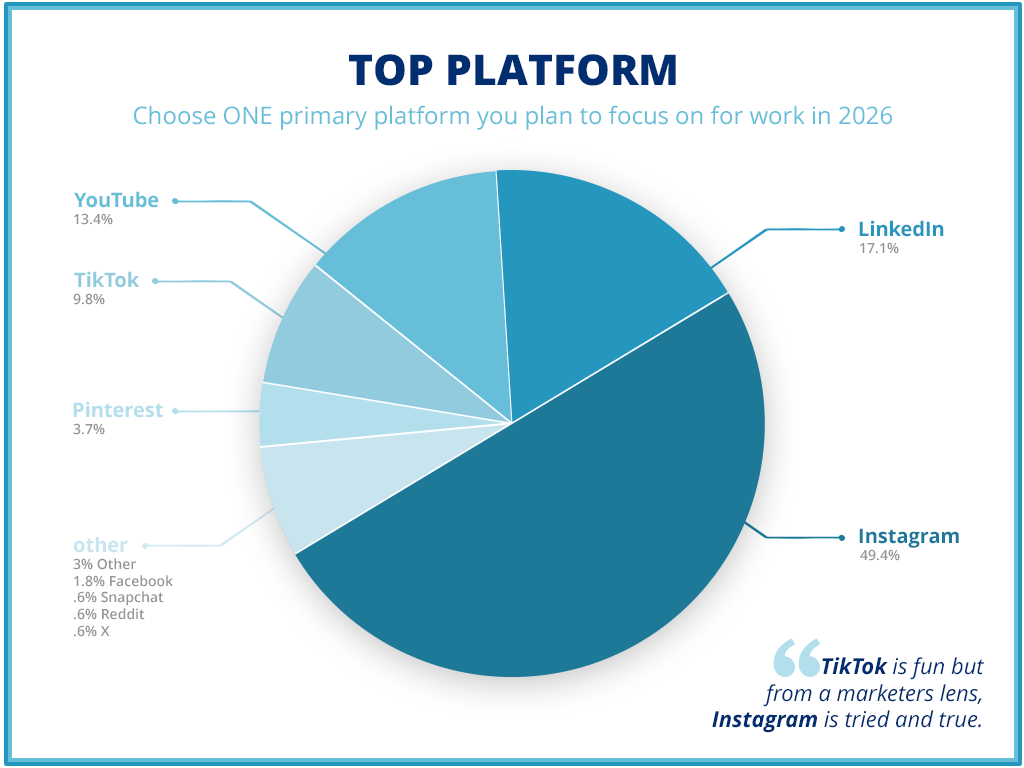
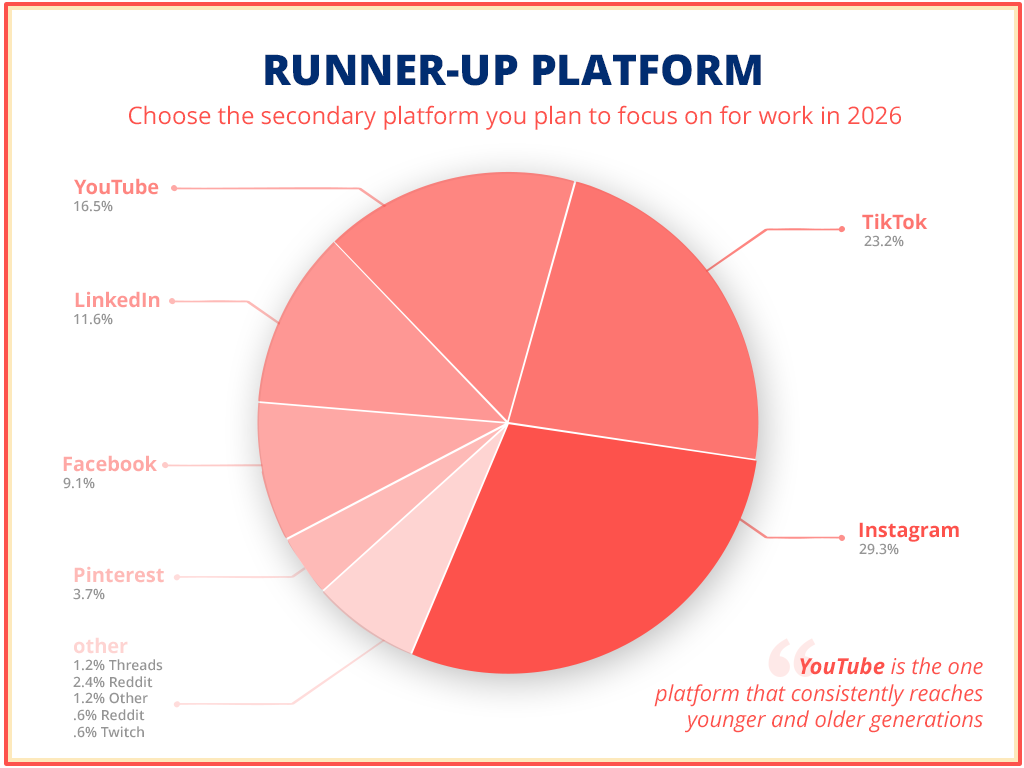
I asked everyone to choose the primary platform they’d be focused on next year. The top 3 results were Instagram (49.4%), LinkedIn (17.1%) and YouTube (13.4%) — while TikTok (9.8%) squeaked in fourth. Then I asked for their secondary platform choice and Instagram clinched that too: Instagram (29.3%), followed by TikTok (23.2%) and YouTube (16.5%) — with a nod to LinkedIn (11.6%) in the fourth spot. None of this is exactly a surprise:
“It’s still the most relevant for the types of brands I work with,” said Fractional Marketing Director Siobhan Mallen.
What is more interesting to me is LinkedIn ranking within the top two and top four results in the platforms everyone plans to focus on in 2026. And it’s not exclusive to B2B brands. Responses came from people at B2B, B2B2C and B2C. Just look at how women’s workwear brand M.M.LaFleur launched a LinkedIn newsletter titled The M Dash, how hair care brand Vegamour hired a Chief LinkedIn Advisor, or how Sweet Loren’s cookie company has been sharing their sweet story on LinkedIn. We’re seeing all types on the platform. The shift also extends to casual app users, thought-leaders and creators. “I’m seeing more and more creators invest in LinkedIn and coming over from other platforms,” said fractional CMO Cindy Qiu. Creator Brooke Monk attested to that recently. “I’m very active on LinkedIn. If you haven’t talked to me on LinkedIn, check your DMS. I’m probably at them,” said the creator, who has 15M followers across all the platforms. “I love LinkedIn. I love engaging with the actual economy behind all the brands.” Plus, there’s an untapped potential for B2B and B2C brands on LinkedIn, according to Calendly’s Senior Social Media Marketing Manager, Greg Rokisky, “including a lower CPC for paid targeting.” And it’s the only platform ChatGPT can fully scrape. “That’s a win for AEO, and it’s still growing,” said Zolay Agency Founder, Mandy Hoskinson. Honorable mentions go to Facebook, Pinterest, Reddit, Threads, Snapchat, Twitch, Substack, Letterboxd, Patreon, Pinterest, and Spotify as other platforms people said they planned to explore. In short: Instagram is still number one, but LinkedIn’s rise to number two proves there’s room for professional content and campaigns that are anything but boring.
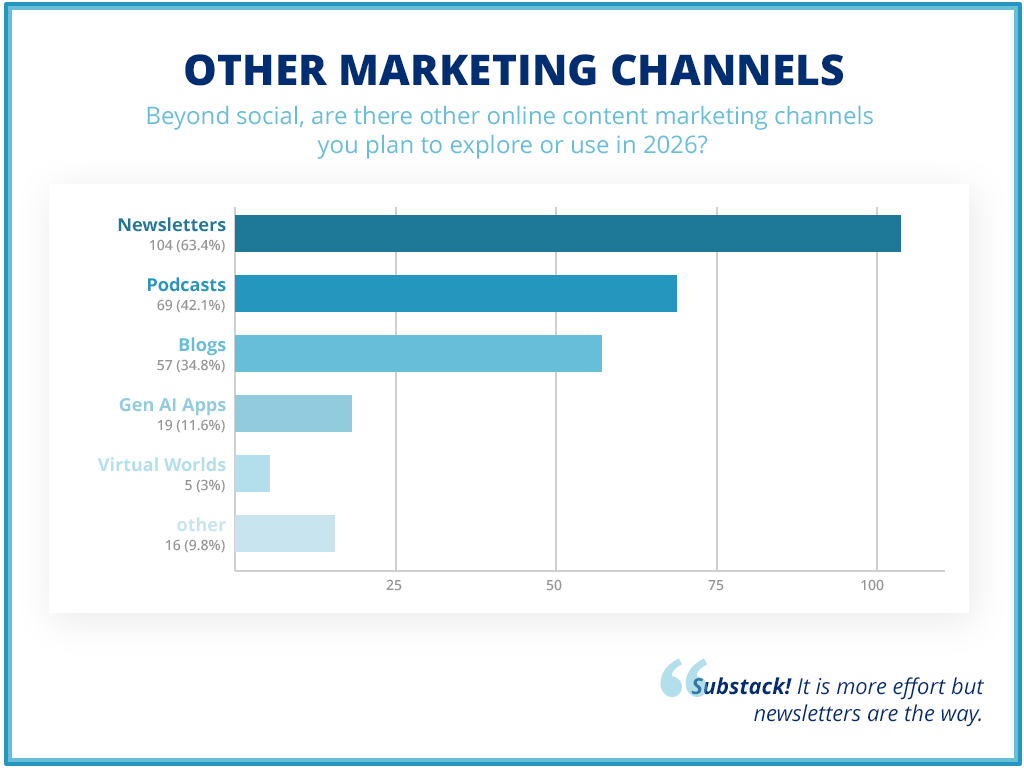
Where Else Is Everyone Showing Up?Newsletters — and Substack in particular — are the most popular choice among the alternative channels and niche platforms people are eyeing for next year.
Newsletters are followed by podcasts — a format that’s seen a flurry of end-of-year activity: Netflix signed a deal with Spotify to add video podcasts to its platform; TikTok partnered with iHeart Radio on a creator podcast network; Vox Media is reportedly considering spinning out its podcast network as a separate business; and Threads just rolled out new features to help podcasters better promote their shows and grow their audiences. As Acast’s Zack Alter put it recently, “Podcasts are a sought, not served medium.” That really aligns with what many of you said you’re craving next year: deeper, more intentional audience relationships.
As for Substack, it got name dropped — a lot. It was mentioned in the ICYMI survey by 27 different brand marketers, continuing a trend I explored earlier this year as brands such as Rare Beauty, Hinge and New York Magazine joined the newsletter platform. Here’s what you said to about the shift to newsletters and finding more intimate and intentional ways to show up for your community online:
But just like other trendy platforms, will the momentum last? Two Bridges Creative agency founder Tighe Flatley doesn’t think so. “Substack use will climb for brands at the start of the year, but only a few will still be using it regularly and successfully by summer 2026,” he predicted. “The brands with a record of understanding content as a long-game will find Substack success; the brands that underestimate the work that goes into consistent publishing will fail and bail.” In short: The newsletter renaissance is real, driven by platform fatigue — but the jury’s still out on which brands are willing to stick with it.🧰 FAVORITE CONTENT FORMATS
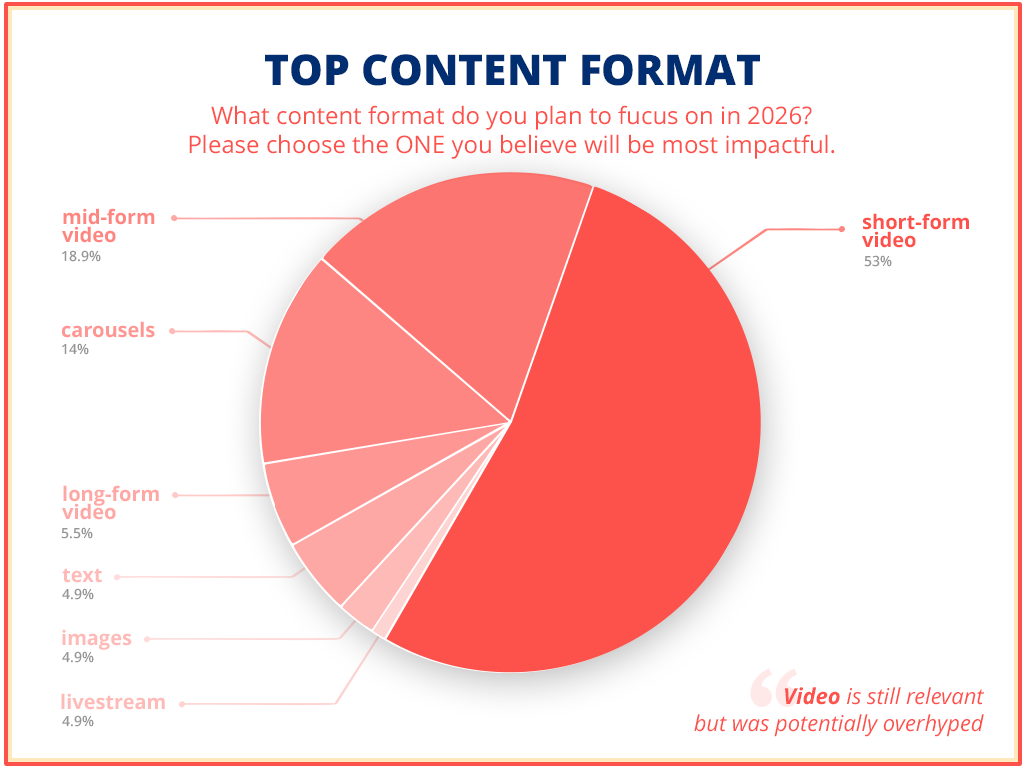
Short-Form Video Can’t Be ToppedMost marketers are not making any major shifts to their content plans in 2026 — it’s about doubling down on what already works, affirmed Rhea Woods, SVP of Influencer and Paid Media at Praytell. That means an overwhelming majority of social teams are forging ahead with short-form video. “We’ve known for a while that short-form video has a lot of power and potential,” said Carolyn MacLeod, Senior Manager of Social Media for PBS Kids. “Data from the last year and announcements from the platforms have truly confirmed that they are our best path forward.” Your choice for top content formats
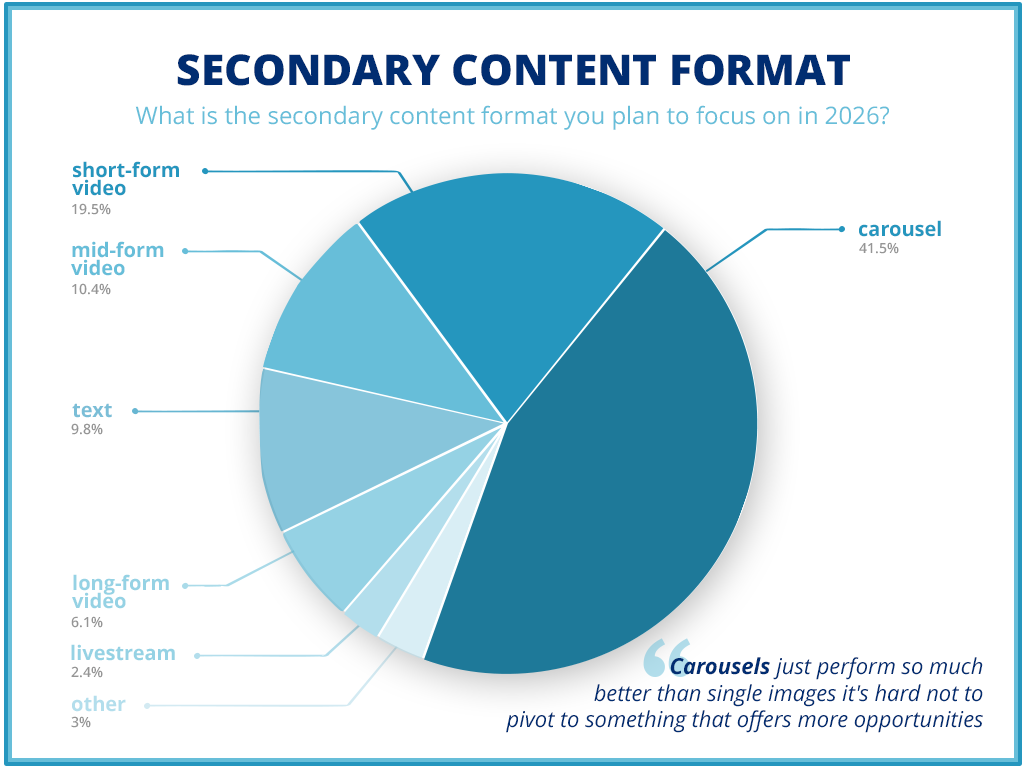
The secondary content formats you’re eyeing
Underneath that consistency, there is a noticeable split between two camps:
“I used to feel very confident in the content type I created for my clients, but with the introduction of SEO strategies, AI, and other shifts, I feel like I’m back at the drawing board trying to see what is resonating,” said Taylor Ion, Social Media Strategist and Owner, The TMI Co. Whether you’re resisting the platform push toward video — from Instagram and TikTok to YouTube and LinkedIn — or finding your current content strategy isn’t working anymore, the good news is short-form video isn’t the only path forward. “Carousels have started to outperform Reels in terms of engagement and impressions,” said Jarod Rodriguez, Social Media Coordinator at The Born Group. Recent data backs this up: Carousels increasingly win on both engagement rate and reach as accounts grow. This holds true even though brand accounts consistently post more Reels than Carousels, regardless of which format actually drives better reach. “We’ve been relying on carousels for a while — it’s hard not to lean into something that gives you more opportunities to connect with your audience,” said an anonymous respondent. But it’s not just carousels. “Historically, we’ve seen pretty solid performance on still images,” said Margaret Rotter, Creative Strategist at Nestig. Others mentioned white papers, case studies, and other text-based content — especially as Substack, Threads, Patreon, and others make a play to win over writer-creators. In short: There’s no one-size-fits-all solution. Video is still king, people are tired — and carousels are the quiet comeback kid.🥰 CREATOR MARKETING
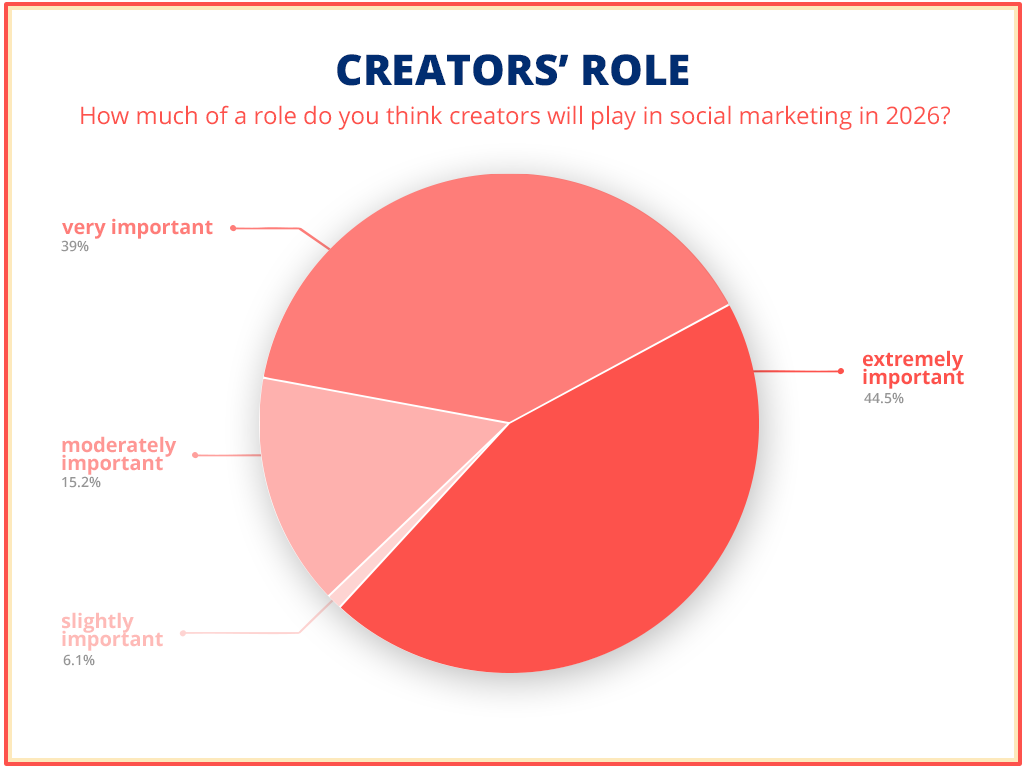
Creator Marketing Is Alive and WellIt’s a landslide: survey respondents think Creator Marketing will be very or extremely important in 2026. This aligns with CreatorIQ’s State of Creator Marketing report showing marketing budgets shifting dollars from digital and paid channels to influencer marketing spend. As for the platform where most creator marketing partnerships will take place? According to the ICYMI community, it ranges from the predictable to next year’s potential sleeper hit:
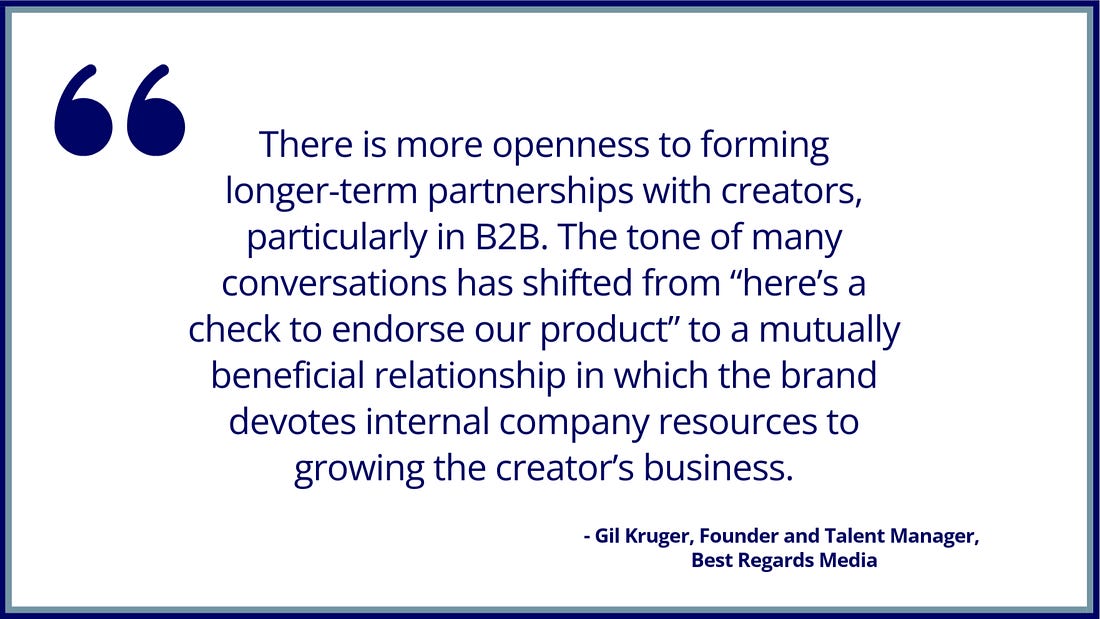
So, what type of creators will people be working with in 2026? “I wish this question were multi-choice,” pointed out Later’s VP, Corporate Marketing & Brand, Kira Klaas, “I usually would include a mix as part of my strategy, although micro might make up a larger chunk.” Indeed, the clear leader is Micro influencers (50.6%) — most people want to work with them for their balance of reach and relatability. “This is the sweet spot for most of my clients. They’re affordable, creative, adaptable, and usually eager to partner,” responded Megan Kaye Marti, Director of Integrated Marketing, Quinn Thomas. The second most popular category was Thought Leaders (22%), showing that expertise and credibility can rival follower count; that was followed by Nano Creators (14%), with smaller but engaged audiences; then Macro (10.4) and Other, UGC and EGC all at 10%. “It’s important for us, as a nonprofit, to have a thought leadership network because it builds credibility, amplifies impact, and extends reach,” said AJ Feuerman, Social Media Strategist, Union for Reform Judaism. “When knowledgeable voices — both inside and outside the organization — speak about the ‘mission,’ it strengthens trust, attracts partners and helps shape public conversation around key issues.” Affiliate creators (1.8%) barely registered a blip. But, of course, some of this may change with the rise of retailers launching creator storefronts (Sephora), their own affiliate programs (Gap) and the continued growth of affiliate platforms like LTK and ShopMy. “The next phase of creator marketing is about ownership. In 2026, I expect affiliate creators to become an even bigger share of the marketing mix. We’re seeing a clear shift toward creators who influence culture and drive measurable commerce outcomes. As Gen Z continues to lead with authenticity, affiliate will define how influence translates to income,” predicted Clair Sidman, VP of Marketing, Collective Voice. As for how these partnerships take place, most campaigns are leaning into short-form video (65.9%), mid-form video (18.3%) is a distant but notable second, while long-form video (4.3%), static images (2.4%), and text-based (1.8%) formats barely register — underscoring how dominant Reels, TikToks, and Shorts have become in creator collaborations. In short: Creator marketing is non-negotiable in 2026, with Instagram as the dominant stage and micro-influencers as the MVPs.
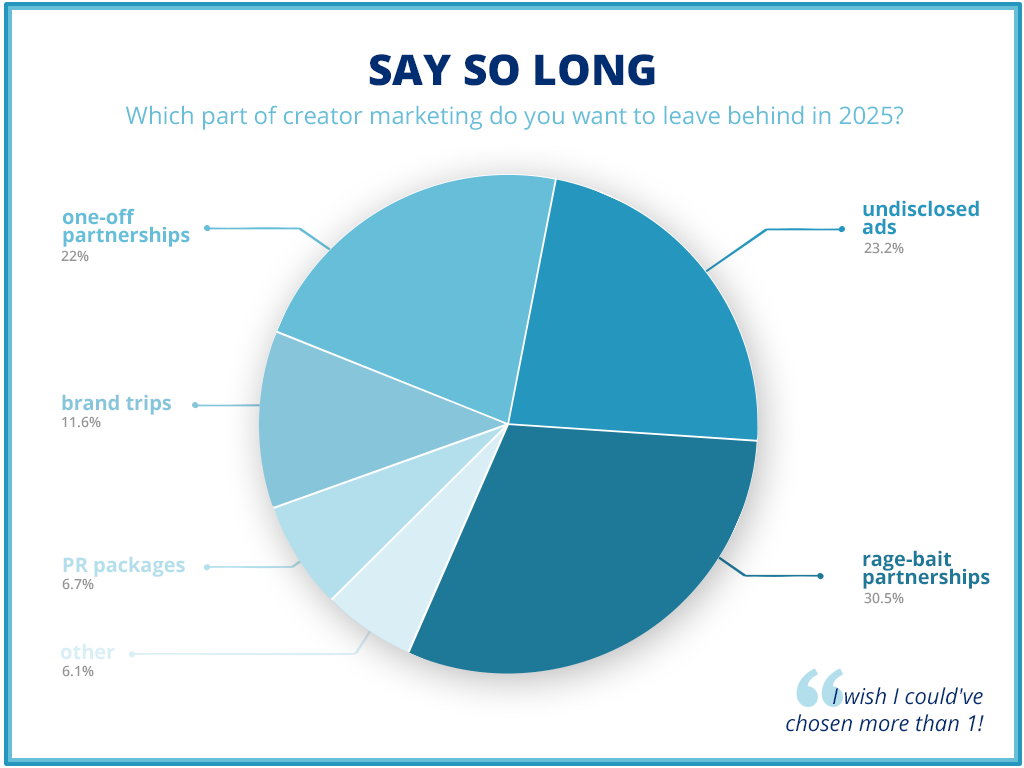
PS. Rage-Bait Partnerships Need to EndWhich part of creator marketing do you want to leave behind in 2025? Christina Garnett, author of Transforming Customer–Brand Relationships, spoke for the majority when she said, “The rage-bait has to go. I am done.”
What you want to leave behind:
This question struck a nerve — despite being optional, it scored a 100% response rate and generated passionate write-in responses. At least three people wanted to select “all of the above.” “This was my favorite question on the survey and honestly, I wish I could’ve chosen more than one!” reacted Rafy Evans, Associate Director of Influencer Strategy & Partnerships at Vayner Media. Creator and Reach founder and CEO Dylan Huey added another category not on the list: “I really don’t like the $10-per-video UGC trend. It’s really cheap.” ✨ THE AI OF IT ALLAI’s Role In Social Marketing
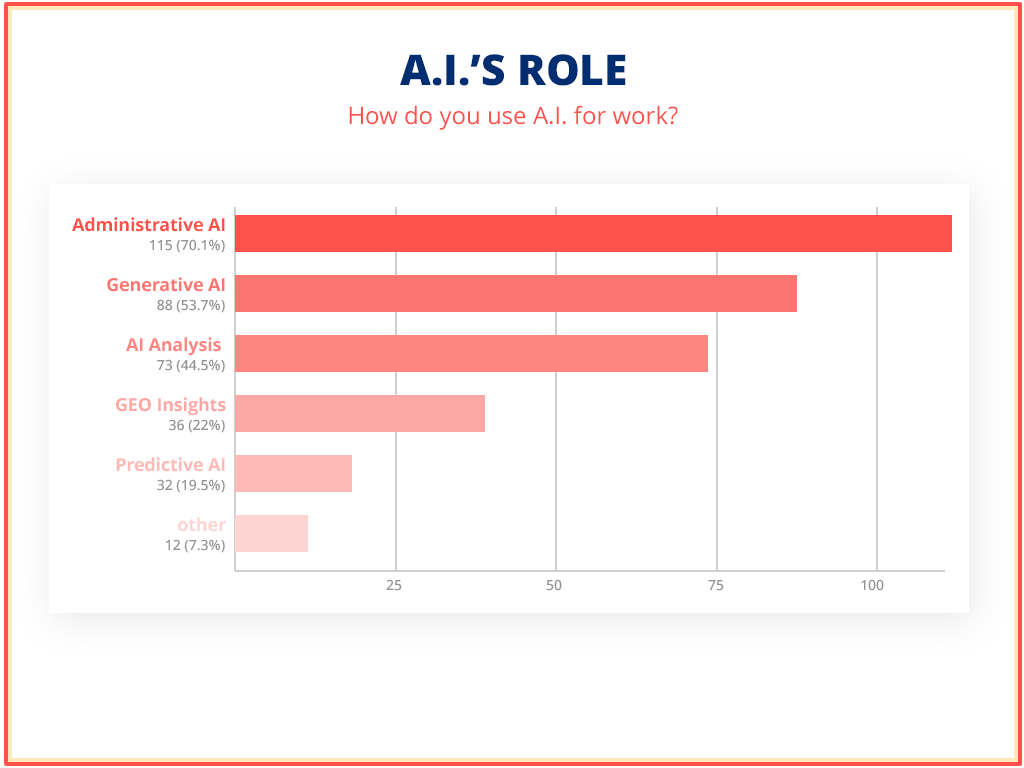
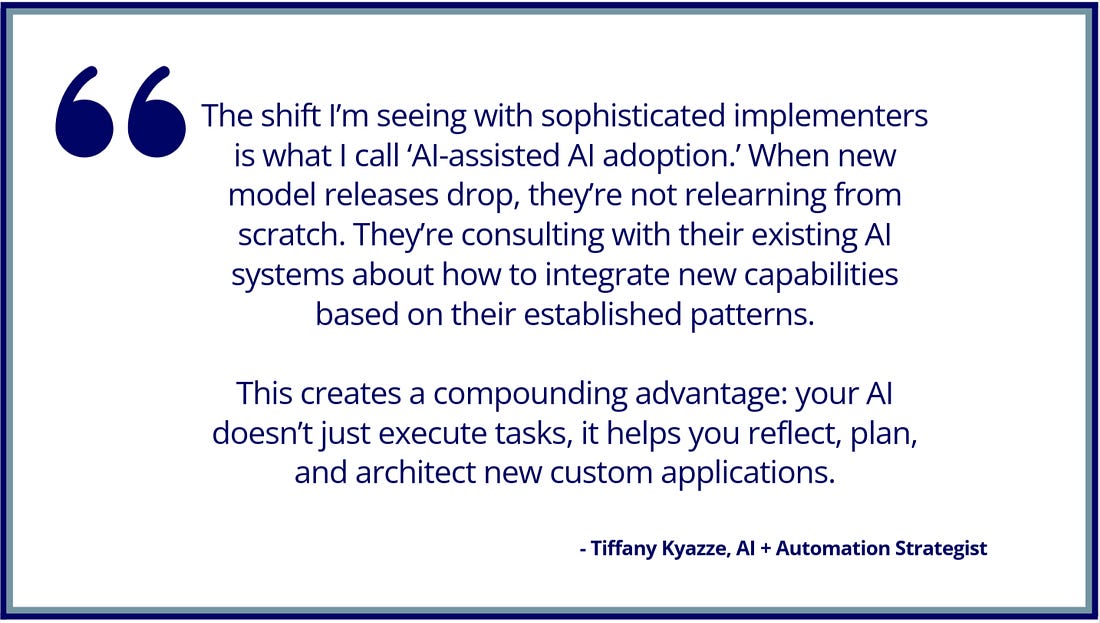
The AI takeover is real — but it’s messier than the hype suggests. How marketers are using AI at work:
The tool hierarchy: ChatGPT dominates (75% of respondents use it), followed by Gemini (30%) and Claude (15%). And most people aren’t monogamous with their AI — they’re mixing and matching tools like ChatGPT + Gemini or Claude + Perplexity + Canva to get the job done. Only 6 people said they don’t use AI at all, signaling near-universal adoption. But widespread use doesn’t mean unconditional love. The resistance factor:
The cautious optimists:
The pragmatists:
The bottom line? AI is here, it’s useful, and almost everyone’s using it — but marketers are getting pickier about when, how, and why they lean on artificial intelligence, with a growing emphasis on keeping the “human” in human-centered marketing. In short: People are tapping into multiple AI tools, whether it’s pairing Motion and ChatGPT to brainstorm new concepts or running copy through Claude and Gemini to avoid generic outputs.
👀 MORE 2026 TRENDS2026 looks like the year of real connection — whether in person, in smaller digital communities, or through in-house studio storytelling. 1. The Return of IRL ConnectionA strong, recurring theme is a shift away from purely digital connection toward real-world, human experiences. That mirrors data we saw earlier this year about consumers desire for offline experiences — especially when it comes to creators. The Influencer Marketing Factory’s Creator IRL Report revealed 41% of U.S. social media users ages 18-65 reported attending at least one in-person influencer event in the past year.
“I will be focusing on networking and creating at in person events and conferences in 2026” - Kianna Lynn, Creator 2. Depth Over BreadthA lot of you are predicting a move from scaling relationships and chasing metrics to building deeper, more meaningful connections with trusted creators and with smaller, intentional audiences. “The real FYP is what you send in group chats” is an iconic line shared by Zaria Parvez two years ago (!) and remains just as relevant as ever.
“There have been a lot of trending content pieces lately and it’s been a bit exhausting. Our audiences aren’t huge fans of it either. I want to be more mindful of that as we head into 2026. Focusing on quality over quantity always, and making sure our audience is represented properly first and foremost” - Kati Hartwig, Sr. Digital Media Specialist at Columbus Regional Airport Authority 3. Brand-Owned Content Studios/In-House ShiftsBrands are moving production in-house, building out their own content studios and collaborating with creators purely for their content creation skills, not their follower counts. It’s part of a growing trend reflected in programs such as UnderAmour’s Lab96 Studios, Dick’s Sporting Goods’ Cookie Jar & A Dream Studios, and Unilever’s Beauty AI Studio.
“Bringing influencer/creator marketing back in house is a rising trend and something we’re testing next year. Creators want to know the brands — not the middle man. Brands want to establish lasting relationships that don’t disappear if an agency does. It’ll help create efficiencies for us and cultivate stronger connectivity for the long term” -Anonymous TL;DR
That’s it! Thank you to everyone who contributed!Let me know in the comments: Does this line up with your 2026 social strategy? Is there anything else that we all missed?And if you liked this post, please give it a ❤️︎ , repost or leave a comment! It helps and it costs $0.00.*164 people from the ICYMI community took part in this year’s survey. The majority of respondents (89%) identified as professionals, meaning content creation wasn’t their primary job, while 11% were self-declared content creators. The people who took this survey ranged from entry level to C-Suite and work across roles in-house and agency in everything from retail, nonprofit, civic institutions, startups, global enterprises, and more. You're currently a free subscriber to ICYMI by Lia Haberman. For the full experience, upgrade your subscription.
|